Mock Tudor cladding
Traditionally Tudor homes were built using a timber frame, unremarkably oak timber posts and beams which were then infilled with 'wattle and daub' constructed by the use of thin oak uprights or 'staves', which are interwoven with hazel strips to grade a rigid panel. This was then plastered with a mixture of clay, dung and chopped straw and left to dry. To protect it from the weather, it was whitewashed. It'south no surprise to hear that this form of structure no longer meets our Warranty requirements.
In modern structure some architects wish to replicate this event by planting timbers on masonry crenel walls and rendering between them. Over the years nosotros have had a number of claims where this has been incorrectly constructed and failed prematurely. More than recently we accept had an increased number of enquires of mock Tudor cladding on external walls.
This prototype beneath demonstrates what tin can go wrong, in this instance the timber has been planted onto the external masonry cavity wall and the panels rendered in between. Motility in the timber then leads to water ingress behind the render and premature failure of the render organisation.
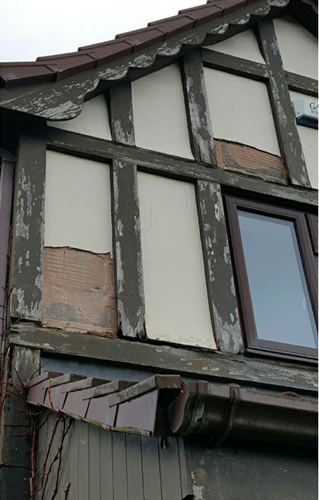
To minimise the chance of premature render failure the wall should exist rendered in its entirety and the timber planted onto the render. This way the render is continuous throughout and whatsoever shrinkage of the timber does not bear upon the water tightness of the render.
Other key points for mock Tudor cladding are as follows:
- To minimise movement, all timber used for mock Tudor cladding, regardless of species, should be kiln dried
- Information technology'southward recommended that the timber is not sealed against the render every bit the likelihood is that this can lead to wet being trapped backside the construction, east.g. where horizontal timbers are against the wall the tiptop more exposed mastic seal may neglect first allowing wet in, whilst the lesser mastic seal remains intact trapping the moisture backside
- In general, it is amend to fix the timber 'Pith out' which means any warping across the width of the timber and then the edges will warp towards the wall. Using just quarter sawn timber will too help reduce this, however information technology'southward incredibly expensive
- Depending on the desired visual issue, timber thickness tin can range from 19-40mm max. 40mm is generally the maximum, equally thicker timbers can exert higher forces when warping which can pull the fixings out
- Due to the limited admission, the back of the timber should be busy/stained before information technology is stock-still to the wall
- In terms of life span, the functional requirements of the LABC Warranty Technical Transmission discusses decorative claddings which, with the return behind, would be applicative in this scenario: 'Decorative Claddings': Whilst there is and can exist no policy responsibility and/or liability for a functioning life of 60 years or less for a 'cladding' which has a 'decorative function only' (i.e. with the main substrate wall structure providing the chief weather-proof barrier), a 'decorative' type cladding shall be designed and synthetic and so they take an intended life of not less than 15 years. Therefore, a minimum form of moderately durable timber should be used to achieve a 15-year durability. A slightly durable timber (coated) may achieve 15 years if treated with an ongoing maintenance program in place. Yet, as the rear face up of the timber cannot be treated, a minimum grade of moderately durable timber should be used, e.g. cedar, Douglas fir, oak, etc.
- When jointing mock Tudor cladding a butt articulation is sufficient. Halved joints should be avoided, due to the potential to trap wet and biscuit joints as well avoided, as often the biscuit is also not durable plenty
Specific to oak:
- Where oak is specified, the fixings should not react with the timber or timber treatment, therefore stainless steel fixings are recommended
- With oak, at that place is a take a chance of extractive staining, where moisture will remove tannings from the oak and stain the render (especially where light renders are used)
- Equally above, the oak used in mock Tudor cladding should be kiln dried
Summary
We have seen a number of enquiries regarding the use of mock Tudor cladding. As this is not an area which we currently accept guidance within the Technical Manual nosotros have outlined some cardinal areas to look for where mock Tudor cladding is specified.


0 Response to "How To Fix Mock Tudor Boards"
Post a Comment