

Lesson 9 Problem Set 5.2
Engage NY Eureka Math 7th Grade Module 2 Lesson 9 Answer Key
Eureka Math Grade 7 Module 2 Lesson 9 Case Respond Key
Represent each of the following expressions as one rational number. Prove and explicate your steps.
Case ane.
4\(\frac{4}{seven}\) – (4\(\frac{4}{7}\) – x)
= 4\(\frac{4}{vii}\) – (4\(\frac{4}{seven}\) + (- 10)) Subtracting a number is the same every bit adding its inverse.
= 4\(\frac{4}{7}\) + (- 4\(\frac{4}{7}\) + 10) The opposite of a sum is the sum of its opposites.
= (4\(\frac{4}{7}\) + (- 4\(\frac{4}{7}\))) + 10 The associative property of addition
= 0 + 10 A number plus its opposite equals zero.
= 10
Example ii.
5 + (- 4\(\frac{4}{7}\))
= v + (- (4 +\(\frac{four}{7}\))) The mixed number 4\(\frac{four}{7}\) is equivalent to 4 +\(\frac{4}{7}\).
= 5 + (- 4 + (-\(\frac{iv}{seven}\))) The contrary of a sum is the sum of its opposites.
= (v + (- 4)) + (-\(\frac{4}{vii}\)) Associative property of addition
= 1 + (-\(\frac{four}{vii}\)) 5 + (- iv) = 1
=\(\frac{7}{7}\) + (-\(\frac{4}{vii}\))\(\frac{vii}{7}\) =1
=\(\frac{three}{7}\)
Eureka Math Class vii Module 2 Lesson ix Exercise Answer Key
Practice i
Unscramble the cards, and show the steps in the correct club to arrive at the solution to v\(\frac{2}{nine}\) – (viii.1 + 5\(\frac{ii}{ix}\)) .
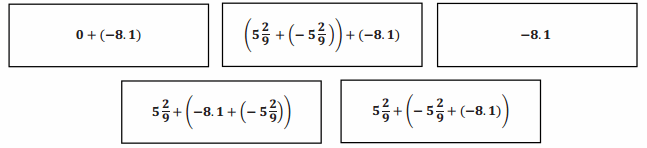
Answer:
5\(\frac{two}{9}\) + (- 8.one + (- 5\(\frac{2}{9}\)) ) The reverse of a sum is the sum of its opposites.
5\(\frac{2}{ix}\) + (- 5\(\frac{2}{9}\) + (- 8.1)) Apply the commutative property of improver.
(five\(\frac{two}{9}\) + (- 5\(\frac{two}{9}\)) ) + (- 8.1) Apply the associative belongings of improver.
0 + (- 8.i) A number plus its reverse equals zero.
– eight.1 Utilize the additive identity property.
Exercise two.
Team Piece of work!
a. – 5.two – (-3.1) + 5.2
Respond:
= – 5.2 + three.1 + 5.two
= – 5.ii + 5.2 + three.1
= 0 + three.1
= three.1
b. 32 + (- 12\(\frac{7}{8}\))
Answer:
= 32 + (- 12 + (-\(\frac{7}{8}\)) )
= (32 + (- 12)) + (-\(\frac{7}{eight}\))
= 20 + (-\(\frac{7}{8}\))
= nineteen\(\frac{one}{eight}\)
c. three\(\frac{1}{6}\) + 20.3 – (- 5\(\frac{five}{6}\))
= 3\(\frac{i}{half dozen}\) + 20.3 + v\(\frac{5}{six}\)
= 3\(\frac{1}{half-dozen}\) + 5\(\frac{5}{6}\) + twenty.3
= 8\(\frac{6}{6}\) + 20.iii
= 9 + 20.3
= 29.3
d.\(\frac{16}{20}\) – (- 1.viii) –\(\frac{four}{five}\)
=\(\frac{sixteen}{20}\) + 1.8 –\(\frac{four}{five}\)
=\(\frac{sixteen}{20}\) + 1.eight + (-\(\frac{4}{5}\))
=\(\frac{16}{20}\) + (-\(\frac{4}{5}\)) + 1.8
=\(\frac{xvi}{20}\) + (-\(\frac{sixteen}{twenty}\)) + ane.8
= 0 + i.8
= ane.8
Exercise three.
Explicate, pace by step, how to arrive at a single rational number to represent the following expression. Show both a written explanation and the related math piece of work for each step.
– 24 – (-\(\frac{ane}{2}\)) – 12.5
Answer:
Subtracting (-\(\frac{1}{2}\)) is the same as adding its inverse\(\frac{ane}{2}\): = – 24 +\(\frac{1}{2}\) + (- 12.5)
Next, I used the commutative property of improver to rewrite the expression: = – 24 + (- 12.5) +\(\frac{1}{2}\)
Next, I added both negative numbers: = – 36.5 +\(\frac{1}{two}\)
Next, I wrote\(\frac{i}{2}\) in its decimal form: = – 36.5 + 0.v
Lastly, I added – 36.5 + 0.5: = – 36
Eureka Math Course 7 Module 2 Lesson 9 Problem Set up Answer Key
Show all steps taken to rewrite each of the post-obit as a single rational number.
Question i.
80 + (- 22\(\frac{4}{15}\))
= fourscore + (-22 + (-\(\frac{four}{15}\)))
= (eighty + (-22)) + (-\(\frac{four}{15}\))
= 58 + (-\(\frac{4}{fifteen}\))
= 57\(\frac{11}{xv}\)
Question 2.
10 + (- 3\(\frac{iii}{viii}\))
Reply:
= 10 + (- 3 + (-\(\frac{3}{viii}\)))
= (x + (- 3)) + (-\(\frac{3}{8}\))
= 7 + (-\(\frac{three}{viii}\))
= half dozen\(\frac{5}{8}\)
Question 3.
\(\frac{1}{5}\) + xx.3 – (-five\(\frac{3}{5}\))
= \(\frac{1}{five}\) + twenty.3 + 5\(\frac{3}{5}\)
= \(\frac{1}{five}\) + 5\(\frac{3}{v}\) + 20.3
= 5\(\frac{four}{5}\) + 20.3
= v\(\frac{four}{5}\) + 20\(\frac{3}{10}\)
= 5\(\frac{8}{x}\) + 20\(\frac{3}{10}\)
= 25\(\frac{eleven}{10}\)
= 26\(\frac{ane}{10}\)
Question iv.
(\(\frac{11}{12}\)) – (- 10) – \(\frac{5}{vi}\)
Answer:
= (\(\frac{11}{12}\)) + x + (-\(\frac{v}{half dozen}\))
= (\(\frac{11}{12}\)) + (-\(\frac{5}{6}\)) + ten
= (\(\frac{11}{12}\)) + (- \(\frac{10}{12}\)) + 10
= (\(\frac{1}{12}\)) + 10
= x (\(\frac{1}{12}\))
Question 5.
Explain, pace by step, how to go far at a single rational number to stand for the following expression. Show both a written explanation and the related math work for each stride.
ane – \(\frac{3}{4}\) + (- 12\(\frac{1}{4}\))
Answer:
First, I rewrote the subtraction of \(\frac{3}{4}\) as the addition of its inverse – \(\frac{3}{4}\):
= one + (- \(\frac{iii}{4}\)) + (- 12\(\frac{1}{4}\))
Next, I used the associative holding of improver to regroup the addend:
= 1 + ((- \(\frac{3}{4}\)) + (- 12\(\frac{1}{four}\)))
Next, I separated – 12\(\frac{1}{4}\) into the sum of – 12 and –\(\frac{1}{4}\):
= ane + ((-\(\frac{3}{4}\)) + (- 12) + (-\(\frac{1}{4}\)))
Next, I used the commutative property of add-on:
= 1 + ((- \(\frac{3}{4}\)) + (-\(\frac{one}{4}\)) + (- 12))
Next, I institute the sum of – \(\frac{three}{iv}\) and –\(\frac{1}{4}\):
= 1 + ((- 1) + (- 12))
Next, I constitute the sum of – ane and – 12:
= 1 + (- 13)
Lastly, since the absolute value of xiii is greater than the absolute value
of 1, and it is a negative 13, the answer will be a negative number.
The accented value of 13 minus the accented value of 1 equals 12,
so the answer is – 12.
= – 12
Eureka Math Grade vii Module 2 Lesson nine Integer Subtraction Round one Respond Cardinal
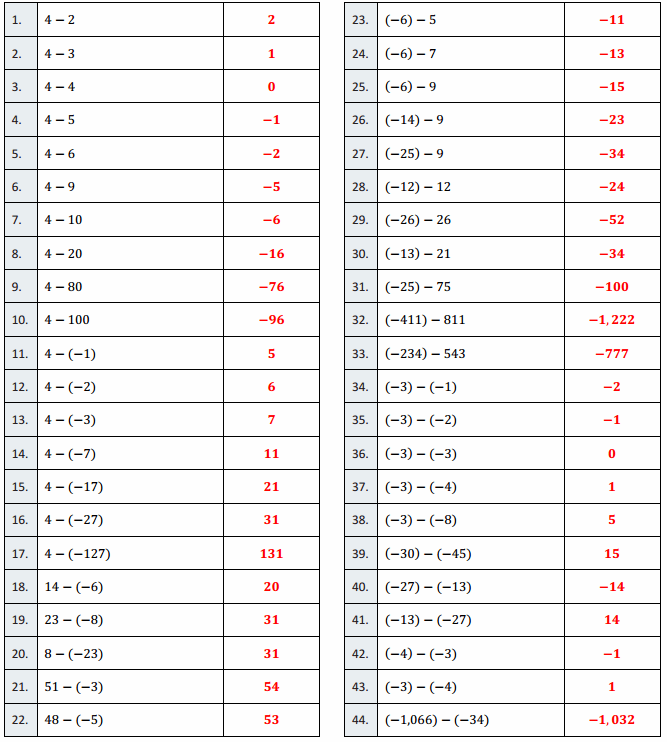
Directions: Determine the difference of the integers, and write it in the column to the right.
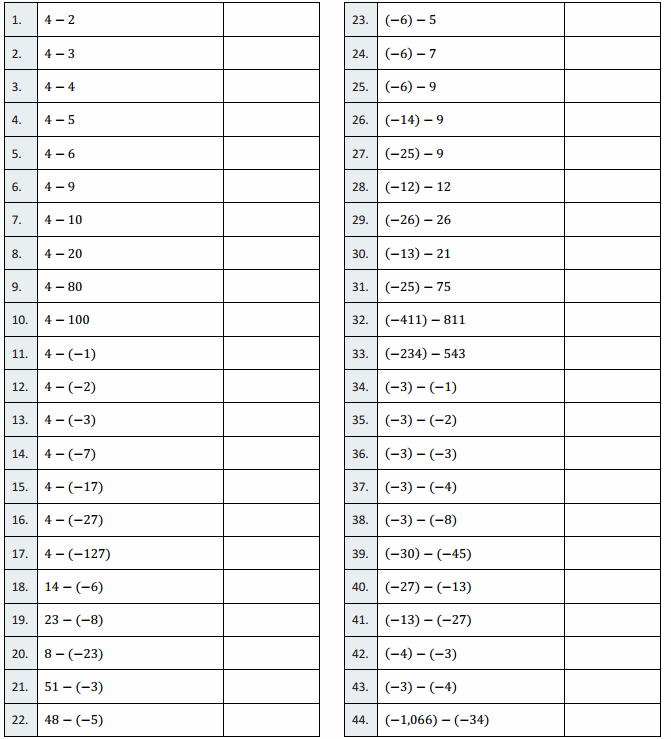
Answer:
Question 1.
4 – 2
Answer:
two
Question 2.
4 – 3
Reply:
1
Question 3.
four – 4
Answer:
0
Question 4.
4 – five
– 1
Question 5.
4 – 6
Respond:
– two
Question half-dozen.
4 – 9
Answer:
– five
Question 7.
four – x
Answer:
– half-dozen
Question 8.
4 – 20
Answer:
– 16
Question 9.
4 – 80
Answer:
– 76
Question 10.
four – 100
Answer:
– 96
Question eleven.
4 – (- i)
Reply:
five
Question 12.
4 – (- two)
Respond:
6
Question 13.
4 – (- 3)
Respond:
7
Question 14.
4 – (- 7)
Reply:
11
Question 15.
four – (- 17)
Answer:
21
Question 16.
four – (- 27)
Answer:
31
Question 17.
4 – (- 127)
Answer:
131
Question 18.
14 – (- six)
Answer:
twenty
Question 19.
23 – (- 8)
Answer:
31
Question 20.
8 – (- 23)
Answer:
31
Question 21.
51 – (- 3)
Answer:
54
Question 22.
48 – (- 5)
Answer:
53
Question 23.
(- vi) – 5
Reply:
– eleven
Question 24.
(- 6) – 7
– xiii
Question 25.
(- 6) – 9
Reply:
– 15
Question 26.
(- 14) – 9
Respond:
– 23
Question 27.
(- 25) – 9
Answer:
– 34
Question 28.
(- 12) – 12
Answer:
– 24
Question 29.
(- 26) – 26
Answer:
– 52
Question 30.
(- 13) – 21
Reply:
– 34
Question 31.
(- 25) – 75
Answer:
– 100
Question 32.
(- 411) – 811
Answer:
– one,222
Question 33.
(- 234) – 543
Answer:
– 777
Question 34.
(- 3) – (- 1)
Respond:
– 2
Question 35.
(- 3) – (- 2)
Answer:
– i
Question 36.
(- 3) – (- 3)
Answer:
0
Question 37.
(- three) – (- 4)
Answer:
1
Question 38.
(- three) – (- viii)
Answer:
5
Question 39.
(- xxx) – (- 45)
Reply:
xv
Question 40.
(- 27) – (- 13)
Answer:
– fourteen
Question 41.
(- xiii) – (- 27)
Answer:
14
Question 42.
(- 4) – (- 3)
Reply:
– ane
Question 43.
(- 3) – (- iv)
Answer:
1
Question 44.
(- ane,066) – (- 34)
Reply:
– 1,032
Eureka Math Grade seven Module 2 Lesson 9 Integer Subtraction Round 2 Respond Key
Directions: Make up one's mind the difference of the integers, and write it in the cavalcade to the right.
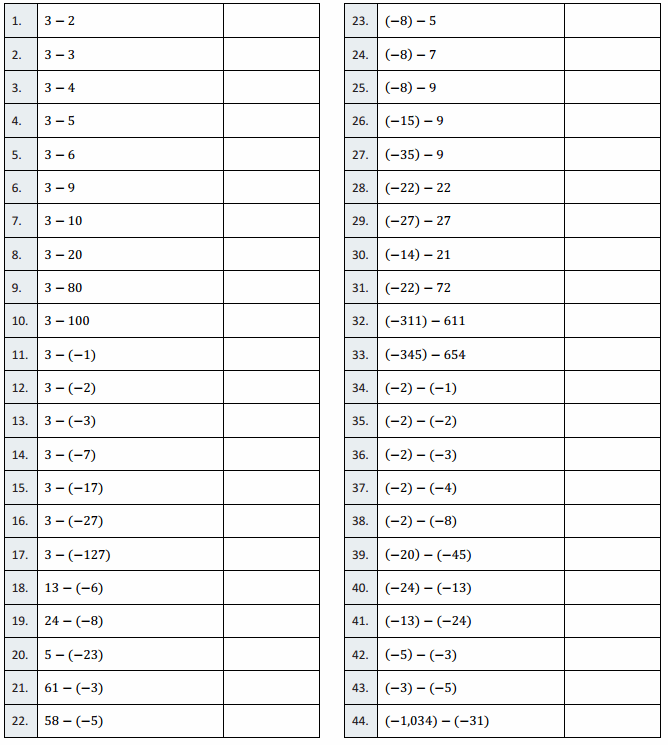
Answer:
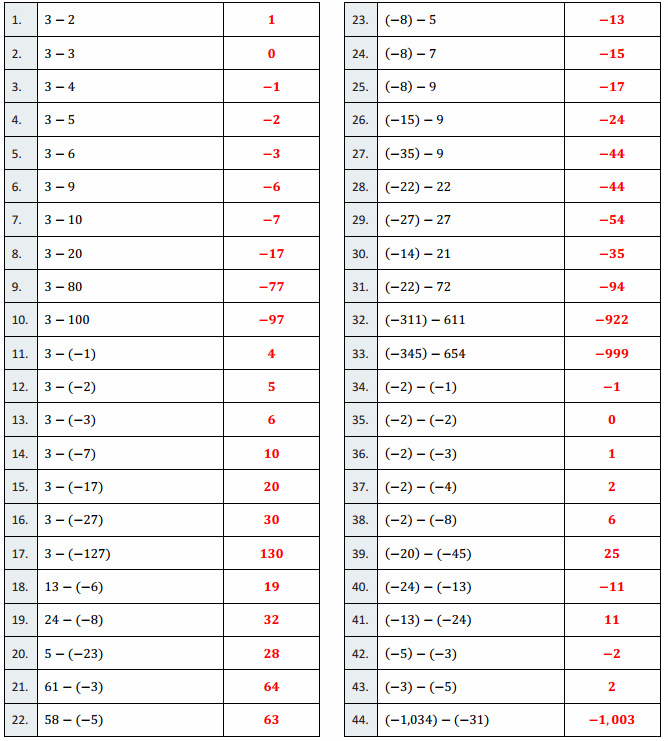
Question one.
3 – 2
Answer:
one
Question 2.
3 – 3
Answer:
0
Question 3.
3 – 4
Answer:
– ane
Question four.
3 – 5
Answer:
– 2
Question 5.
iii – 6
Answer:
– 3
Question half dozen.
3 – 9
Answer:
– six
Question 7.
3 – 10
Answer:
– 7
Question 8.
iii – 20
Answer:
– 17
Question ix.
3 – 80
Answer:
– 77
Question ten.
3 – 100
Answer:
– 97
Question xi.
iii – (- 1)
Answer:
4
Question 12.
three – (- 2)
Answer:
5
Question 13.
iii – (- 3)
Respond:
6
Question 14.
3 – (- 7)
Respond:
10
Question 15.
3 – (- 17)
Answer:
twenty
Question 16.
three – (- 27)
Respond:
30
Question 17.
3 – (- 127)
Reply:
130
Question xviii.
thirteen – (- 6)
Reply:
19
Question 19.
24 – (- viii)
Answer:
32
Question 20.
five – (- 23)
Respond:
28
Question 31.
61 – (- 3)
Answer:
64
Question 32.
58 – (- v)
Answer:
63
Question 33.
(- eight) – 5
Answer:
– 13
Question 34.
(- viii) – seven
Reply:
– xv
Question 35.
(- eight) – 9
Answer:
– 17
Question 36.
(- 15) – 9
Reply:
– 24
Question 37.
(- 35) – 9
Answer:
– 44
Question 38.
(- 22) – 22
Respond:
– 44
Question 39.
(- 27) – 27
Answer:
– 54
Question 40.
(- 14) – 21
Respond:
– 35
Question 41.
(- 22) – 72
Respond:
– 94
Question 42.
(- 311) – 611
Respond:
– 922
Question 43.
(- 345) – 654
Answer:
– 999
Question 44.
(- two) – (- ane)
Answer:
– one
Question 45.
(- 2) – (- ii)
Answer:
0
Question 46.
(- 2) – (- iii)
Answer:
1
Question 47.
(- 2) – (- iv)
Respond:
2
Question 48.
(- 2) – (- eight)
Answer:
6
Question 49.
(- 20) – (- 45)
Answer:
25
Question 41.
(- 24) – (- 13)
Answer:
– 11
Question 42.
(- 13) – (- 24)
Respond:
eleven
Question 43.
(- 5) – (- iii)
Answer:
– 2
Question 44.
(- iii) – (- five)
Answer:
ii
Question 45.
(- 1,034) – (- 31)
Reply:
– 1,003
Eureka Math Grade 7 Module 2 Lesson 9 Exit Ticket Respond Central
Question 1.
Jamie was working on his math homework with his friend, Kent. Jamie looked at the post-obit problem.
-ix.5 – (-8) – half-dozen.v
He told Kent that he did not know how to decrease negative numbers. Kent said that he knew how to solve the problem using simply addition. What did Kent hateful by that? Explicate. Then, show your work, and stand for the answer as a single rational number.
Answer:
Kent meant that since whatsoever subtraction trouble tin exist written equally an improver problem by calculation the opposite of the number you are subtracting, Jamie tin solve the problem by using but improver.
Work Space:
-9.5 – (-8) – 6.5
= -ix.5 + 8 + (-half dozen.5)
= -9.5 + (-6.5) + 8
= -16 + 8
= -8
Respond:
-8
Question 2.
Use one rational number to stand for the following expression. Show your work.
three + (- 0.2) – 15\(\frac{one}{4}\)
Respond:
= three + (-0.2) + (-15 + (-\(\frac{1}{four}\)))
= iii + (-0.2 + (-15) + (- 0.25))
= iii + (-fifteen.45)
= -12.45

Lesson 9 Problem Set 5.2,
Source: https://ccssmathanswers.com/eureka-math-grade-7-module-2-lesson-9/
Posted by: howardraws1999.blogspot.com
0 Response to "Lesson 9 Problem Set 5.2"
Post a Comment